Circulating Apelin-17 and Elabela Levels as Predictive Biomarkers of Neurodegeneration and Cognitive Decline in Alzheimer’s Disease
DOI:
https://doi.org/10.47419/bjbabs.v6i3.407Keywords:
Alzheimer’s disease, Apelin-17 , Elabela, IL-6, TNF-αAbstract
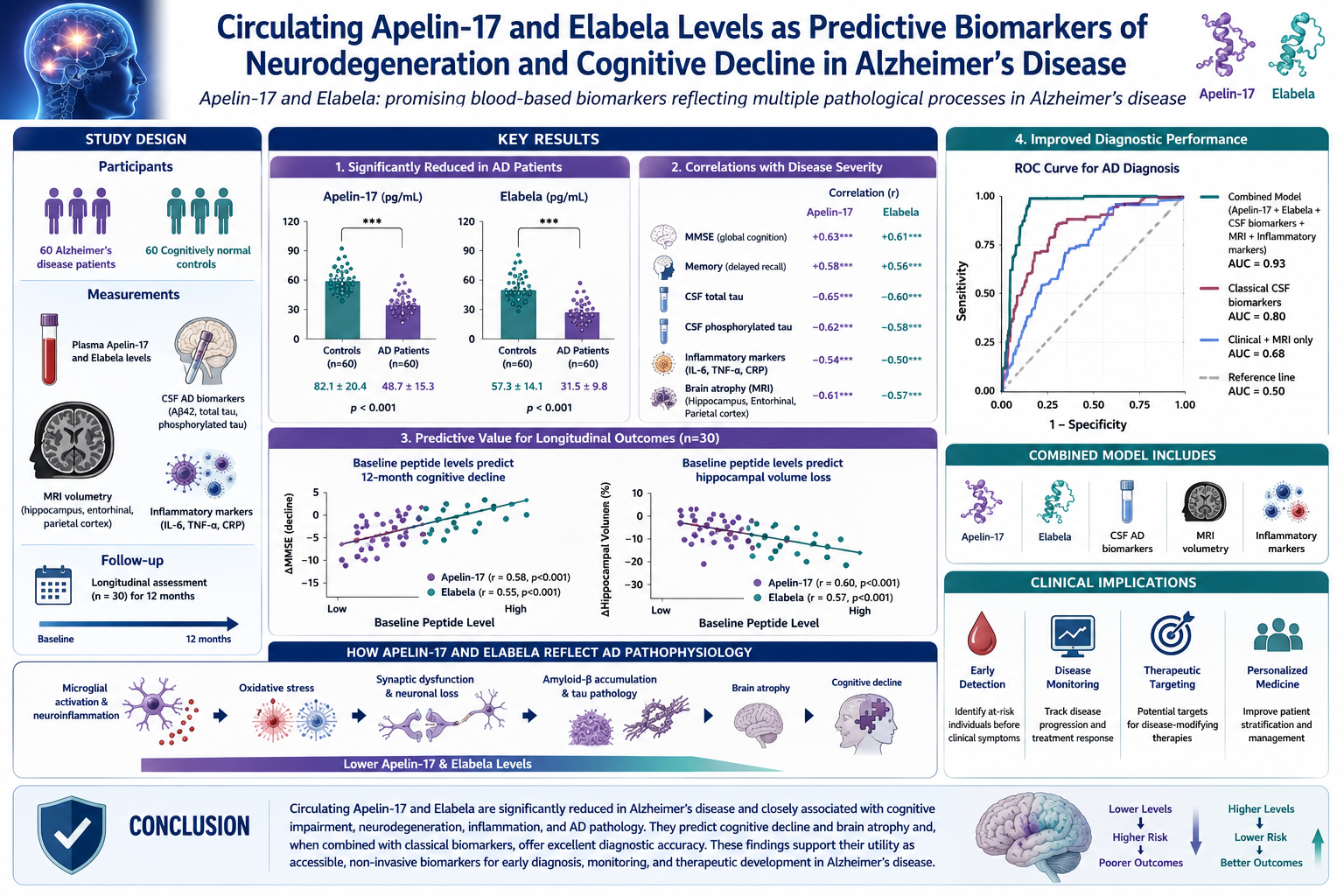
Background: Alzheimer’s disease is characterized by progressive neurodegeneration and cognitive decline. Early diagnosis and monitoring are critical but remain challenging. Apelin-17 and Elabela, endogenous ligands of the apelin receptor (APJ), have emerged as neuroprotective peptides with potential biomarker utility. Objective: To evaluate circulating Apelin-17 and Elabela levels as predictive biomarkers of neurodegeneration and cognitive impairment in Alzheimer’s disease. Methods: We measured plasma Apelin-17 and Elabela in 60 Alzheimer’s disease patients and 60 cognitively normal controls. Correlations with cognitive scores, CSF AD biomarkers (Aβ42, total tau, phosphorylated tau), inflammatory markers (IL-6, TNF-α, CRP), and MRI volumetric data were assessed. A subset (n=30) was followed longitudinally for 12 months. Results: Alzheimer’s disease patients showed significantly reduced Apelin-17 (48.7 ± 15.3 pg/mL vs. 82.1 ± 20.4 pg/mL) and Elabela levels (31.5 ± 9.8 pg/mL vs. 57.3 ± 14.1 pg/mL; p < 0.001 for both). Peptide levels correlated positively with MMSE and specific cognitive domains and inversely with CSF tau, inflammatory markers, and brain atrophy (hippocampus, entorhinal, parietal cortex). Baseline peptides predicted 12-month cognitive decline and hippocampal volume loss. Combined biomarker models including Apelin-17, Elabela, and classical markers improved diagnostic accuracy (AUC=0.93). Conclusion: Circulating Apelin-17 and Elabela are promising predictive biomarkers for neurodegeneration and cognitive decline in Alzheimer’s disease, reflecting multiple pathological processes. They hold potential for early diagnosis, monitoring, and therapeutic targeting.
Downloads
References
Contador. I, B, Del Ser. T, Llamas-Velasco. S, Villarejo-Galende. A, Benito-León. J, Bermejo-Pareja F. Charting Alzheimer’s disease and dementia: epidemiological insights, risk factors and prevention pathways. J. Clin. Med. 2024 ;13(14):4100. doi: 10.3390/jcm13144100. DOI: https://doi.org/10.3390/jcm13144100
Gyimesi. M, Okolicsanyi. RK, Haupt LM. Beyond amyloid and tau: rethinking Alzheimer’s disease through less explored avenues. Open Biology. 2024;14(6):240035.https://doi.org/10.1098/rsob.240035. DOI: https://doi.org/10.1098/rsob.240035
Alshaebi. F, Sciortino. A, Kayed. R. The role of glial cell senescence in Alzheimer's disease. J. Neurochem. 2025;169(3):70051. https://doi.org/10.1111/jnc.70051. DOI: https://doi.org/10.1111/jnc.70051
Kivipelto. M, Helkala. EL, Laakso. MP, Hänninen. T, Hallikainen. M, Alhainen. K, et. al. Midlife vascular risk factors and Alzheimer's disease in later life: longitudinal, population-based study. Bmj. 2001;322(7300): 1447-51. https://doi.org/10.1136/bmj.322.7300.1447. DOI: https://doi.org/10.1136/bmj.322.7300.1447
Liu RM. Aging, cellular senescence, and Alzheimer’s disease. Int. J. Mol. Sci. 2022 ;23(4):1989.https://doi.org/10.3390/ijms23041989. DOI: https://doi.org/10.3390/ijms23041989
Hampel H, Hardy J, Blennow K, Chen C, Perry G, Kim SH, et al. The amyloid-β pathway in Alzheimer’s disease. Molecular psychiatry. 2021 ;26(10):5481-503. https://doi.org/10.1038/s41380-021-01249-0. DOI: https://doi.org/10.1038/s41380-021-01249-0
Nasb M, Tao W, Chen N. Alzheimer's disease puzzle: delving into pathogenesis hypotheses. Aging and Disease. 2024 ;15(1):43. doi: 10.14336/AD.2023.0608. DOI: https://doi.org/10.14336/AD.2023.0608
Sehar. U, Rawat. P, Reddy. AP, Kopel. J, Reddy. PH. Amyloid beta in aging and Alzheimer’s disease. Int. J. Mol. Sci. 2022 ;23(21):12924. https://doi.org/10.3390/ijms232112924. DOI: https://doi.org/10.3390/ijms232112924
Bigi A, Cascella R, Chiti F, Cecchi C. Amyloid fibrils act as a reservoir of soluble oligomers, the main culprits in protein deposition diseases. BioEssays. 2022;44(11):2200086. https://doi.org/10.1002/bies.202200086. DOI: https://doi.org/10.1002/bies.202200086
Akpoghelie PO, Edo GI, Ali SI, Kasar KA, Zainulabdeen K, Mohammed AA, et al. Effect of processing on the microbiological, proximate, antinutritional and mineral profile of selected yellow cassava varieties and sorghum malt as potential raw materials for alcoholic beverage production. Beverage Plant Research. 2024;4(1)55-57.doi: 10.48130/bpr-0024-0022. DOI: https://doi.org/10.48130/bpr-0024-0022
Joseph B, Thomas S, Sen N, Paschold A, Binder WH, Kumar S. Bioinspired synthetic polymers-based inhibitors of Alzheimer's amyloid-β peptide aggregation. Polym. Chem. 2023;14(4):392-411. https://doi.org/10.1039/D2PY01217K. DOI: https://doi.org/10.1039/D2PY01217K
Pradeepkiran JA, Baig J, Islam MA, Kshirsagar S, Reddy PH. Amyloid-β and phosphorylated tau are the key biomarkers and predictors of Alzheimer’s disease. Aging Dis. 2024;16(2):658.doi: 10.14336/AD.2024.0286. DOI: https://doi.org/10.14336/AD.2024.0286
Wang M, Yan C, Li X, Yang T, Wu S, Liu Q, Luo Q, Zhou F. Non-invasive modulation of meningeal lymphatics ameliorates ageing and Alzheimer’s disease-associated pathology and cognition in mice. Nat. Commun. 2024;15(1):1453. https://doi.org/10.1016/j.neuropharm.2019.107960. DOI: https://doi.org/10.1038/s41467-024-45656-7
Ali LI, Ali SI, Khaleel FM, Hassan WS, Hussein KA, et al. Evaluation of Apelin, Elabela, and Certain Biomarkers in Patients with Metabolic Disease Associated with Obesity. Diyala Journal of Medicine. 2025 ;28(2):1-2. https://doi.org/10.26505/djm.v28i2.1187. DOI: https://doi.org/10.26505/djm.v28i2.1187
Ali SE, Khaleel FM. Assessing the Activity of Renin and GST in the Serum of Ladies Suffering from Polycystic Ovary Syndrome and COVID-19 to Predict the Danger of Cardiac Disease. Baghdad Sci. J. 2023, 20(3): 986-993 https://dx.doi.org/10.21123/bsj. DOI: https://doi.org/10.21123/bsj.2023.7879
Chen J, Zhu Z, Xu Y. Signs of Alzheimer’s Disease: Tied to Aging. Int. J. Mol. Sci. 2025 ;26(11):4974. https://doi.org/10.1007/s12031-019-01264-7. DOI: https://doi.org/10.3390/ijms26114974
Luo H, Han L, Xu J. Apelin/APJ system: a novel promising target for neurodegenerative diseases. J. Cell. Physiol. 2020 ;235(2):638-57. https://doi.org/10.1002/jcp.29001. DOI: https://doi.org/10.1002/jcp.29001
Chen J, Zhu Z, Xu Y. Signs of Alzheimer’s Disease: Tied to Aging. International Journal of Molecular Sciences. 2025 ;26(11):4974.https://doi.org/10.3390/ijms26114974. DOI: https://doi.org/10.3390/ijms26114974
Wang X, Zhang L, Li P, Zheng Y, Yang Y, Ji S. Apelin/APJ system in inflammation. International Immunopharmacology. 2022 ;10(9):108-822.https://doi.org/10.1016/j.intimp.2022.108822. DOI: https://doi.org/10.1016/j.intimp.2022.108822
Xu J, Chen L, Jiang Z, Li L. Biological functions of Elabela, a novel endogenous ligand of APJ receptor. Journal of cellular physiology. 2018 ;233(9):6472-82.https://doi.org/10.1002/jcp.26492. DOI: https://doi.org/10.1002/jcp.26492
Samant NP, Gupta GL. Avicularin attenuates memory impairment in rats with amyloid beta-induced Alzheimer’s disease. Neurotoxicity research. 2022 ;40(1):140-53. https://doi.org/10.1007/s12640-021-00467-2. DOI: https://doi.org/10.1007/s12640-021-00467-2
Balestrieri JV, Nonato MB, Gheler L, Prandini MN. Structural volume of hippocampus and Alzheimer’s disease. Revista da Associação Médica Brasileira. 2020;66(4):512-5. https://doi.org/10.1590/1806-9282.66.4.512 . DOI: https://doi.org/10.1590/1806-9282.66.4.512
Yavuz, M. M., & Erbaş, O. (2022). Elabela peptide ameliorates beta-amyloid-induced cognitive deficits in rats by reducing oxidative stress and apoptosis. Peptides, 150, 170717. https://doi.org/10.1016/j.peptides.2021.170717. DOI: https://doi.org/10.1016/j.peptides.2021.170717
Bian X, Wang Q, Wang Y, Lou S. The function of previously unappreciated exerkines secreted by muscle in regulation of neurodegenerative diseases. Frontiers in Molecular Neuroscience. 2024; 16:1305208. https://doi.org/10.3389/fnmol.2023.1305208. DOI: https://doi.org/10.3389/fnmol.2023.1305208
Luo H, Xiang Y, Qu X, Liu H, Liu C, Li G, Han L, Qin X. Apelin-13 suppresses neuroinflammation against cognitive deficit in a streptozotocin-induced rat model of Alzheimer’s disease through activation of BDNF-TrkB signaling pathway. Frontiers in Pharmacology. 2019 Apr 16; 10:395. https://doi.org/10.3389/fphar.2019.00395. DOI: https://doi.org/10.3389/fphar.2019.00395
Additional Files
Published
Issue
Section
Categories
License
Copyright (c) 2025 Shaimaa Imad Ali, Alabbas Majeed

This work is licensed under a Creative Commons Attribution 4.0 International License.
The authors retain all proprietary rights, including copyright, such as patent and trademark rights and rights to any process or procedure described in the article.