Single Nucleotide Polymorphism (SNP) Assays for Disaster Victim Identification (DVI)
DOI:
https://doi.org/10.47419/bjbabs.v6i03.371Keywords:
Single Nucleotide Polymorphism, SNP, Disaster Victim Identification, DVI, Forensic geneticsAbstract
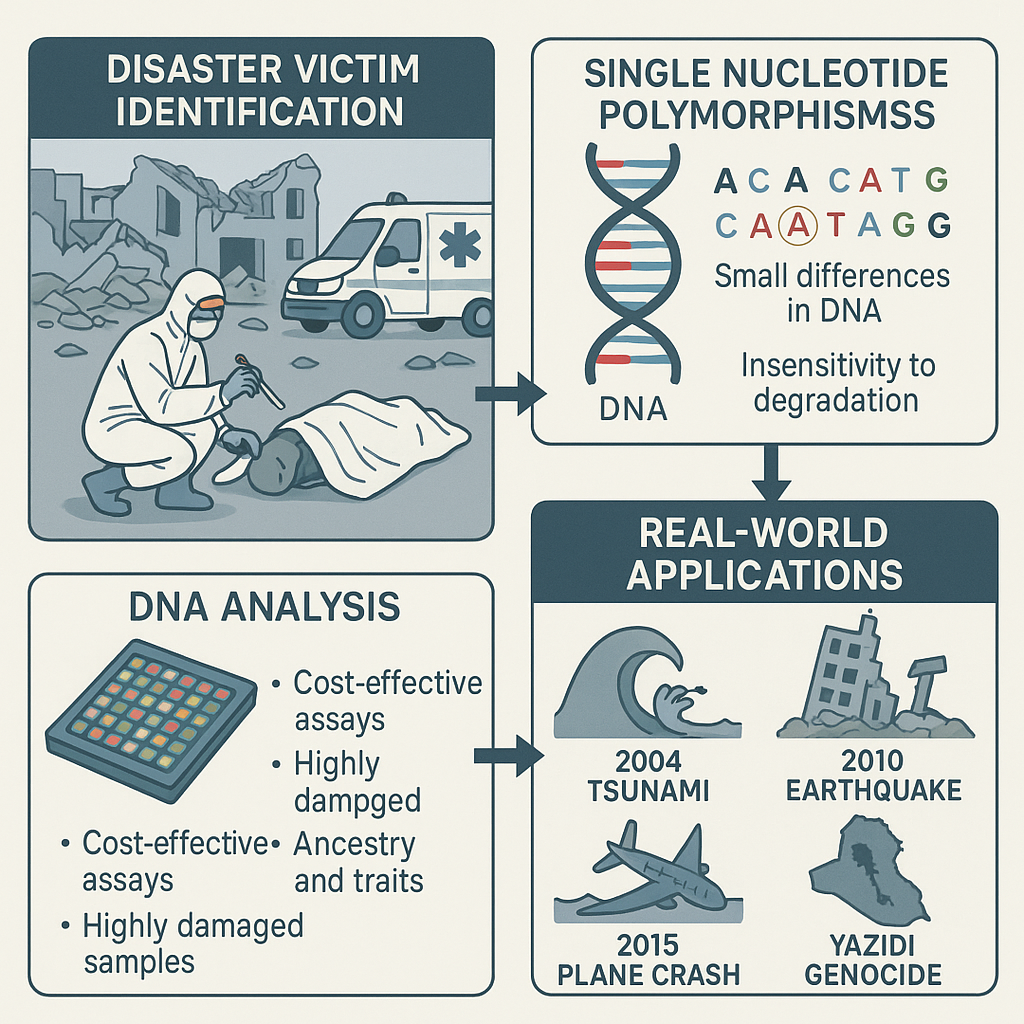
Disaster victim identification (DVI) is crucial in the aftermath of mass casualty events, necessitating rapid and precise identification methods. Single-nucleotide polymorphisms (SNPs) have gained significant prominence in forensic genetics due to their abundance, stability, and ease of analysis. SNPs are highly valuable genetic markers for DVI, particularly because they are insensitive to DNA degradation and possess high annotation potential, making their underlying biological information invaluable for human identification in molecular forensics. Unlike traditional methods, SNP typing offers a more powerful set of genetic markers, enabling complex analysis and profiling techniques suitable for various genotyping scenarios, from specialized forensic markers to expanded tiling arrays. The small differences in DNA due to polymorphisms, approximately 1 in 1,000 nucleotides, provide sufficient information to uniquely identify a person. SNP assays are particularly effective for analyzing severely damaged DNA samples, a common characteristic of disaster remains, as demonstrated in real-world applications such as the 2004 Indian Ocean tsunami, the 2010 Haiti earthquake, the 2015 Germanwings Flight 9525 crash, and the Yazidi Genocide in Iraq. These assays offer advantages including cost-effectiveness, multiplexing capabilities, and suitability for robotic automation. They also provide valuable information for ancestry inference and the prediction of externally visible characteristics. The ongoing development of SNP assay technologies and their use in DVI protocols highlight their important role in giving accurate identifications and helping families find closure.
Downloads
References
. de Boer, H.H., Blau, S., Delabarde, T. and Hackman, L., 2019. The role of forensic anthropology in disaster victim identification (DVI): recent developments and future prospects. Forensic sciences research, 4(4), pp.303-315. DOI: https://doi.org/10.1080/20961790.2018.1480460
Mathur, R., Rana, B.S. and Jha, A.K., 2018. Single nucleotide polymorphism (SNP). Encyclopedia of Animal Cognition and Behavior. Vonk J., Shackelford T.(eds.). Cham., Springer, p.7539. DOI: https://doi.org/10.1007/978-3-319-47829-6_2049-1
Arafah, A., Ali, S., Majid, S., Rashid, S., Rasool, S., Wani, H.A., Rasool, I. and Rehman, M.U., 2021. Single Nucleotide Polymorphisms and Pharmacogenomics. Genetic Polymorphism and cancer susceptibility, pp.23-52. DOI: https://doi.org/10.1007/978-981-33-6699-2_2
Zhang, J., Yang, J., Zhang, L., Luo, J., Zhao, H., Zhang, J., & Wen, C. (2020). A new SNP genotyping technology Target SNP-seq and its application in genetic analysis of cucumber varieties. Scientific reports, 10(1), 5623. DOI: https://doi.org/10.1038/s41598-020-62518-6
Dwiningsih, Y., Rahmaningsih, M. and Alkahtani, J., 2020. Development of single nucleotide polymorphism (SNP) markers in tropical crops. Advance Sustainable Science, Engineering and Technology, 2(2), p.343558. DOI: https://doi.org/10.26877/asset.v2i2.6279
Amiteye, S., 2021. Basic concepts and methodologies of DNA marker systems in plant molecular breeding. Heliyon, 7(10). DOI: https://doi.org/10.1016/j.heliyon.2021.e08093
Tillmar, A., Sturk-Andreaggi, K., Daniels-Higginbotham, J., Thomas, J.T. and Marshall, C., 2021. The FORCE panel: an all-in-one SNP marker set for confirming investigative genetic genealogy leads and for general forensic applications. Genes, 12(12), p.1968. DOI: https://doi.org/10.3390/genes12121968
Guo, Z., Yang, Q., Huang, F., Zheng, H., Sang, Z., Xu, Y., Zhang, C., Wu, K., Tao, J., Prasanna, B.M. and Olsen, M.S., 2021. Development of high-resolution multiple-SNP arrays for genetic analyses and molecular breeding through genotyping by target sequencing and liquid chip. Plant communications, 2(6). DOI: https://doi.org/10.1016/j.xplc.2021.100230
Gettings, K.B., Tillmar, A., Sturk‐Andreaggi, K. and Marshall, C., 2024. Review of SNP assays for disaster victim identification: Cost, time, and performance information for decision‐makers. Journal of Forensic Sciences, 69(5), pp.1546-1557. DOI: https://doi.org/10.1111/1556-4029.15585
Weng, Z., Yang, Y., Wang, X., Wu, L., Hua, S., Zhang, H. and Meng, Z., 2021. Parentage analysis in giant grouper (Epinephelus lanceolatus) using microsatellite and SNP markers from genotyping-by-sequencing data. Genes, 12(7), p.1042. DOI: https://doi.org/10.3390/genes12071042
Zimmerman, S.J., Aldridge, C.L. and Oyler-McCance, S.J., 2020. An empirical comparison of population genetic analyses using microsatellite and SNP data for a species of conservation concern. BMC genomics, 21, pp.1-16. DOI: https://doi.org/10.1186/s12864-020-06783-9
Fola, A.A., Kattenberg, E., Razook, Z., Lautu-Gumal, D., Lee, S., Mehra, S., Bahlo, M., Kazura, J., Robinson, L.J., Laman, M. and Mueller, I., 2020. SNP barcodes provide higher resolution than microsatellite markers to measure Plasmodium vivax population genetics. Malaria Journal, 19, pp.1-15. DOI: https://doi.org/10.1186/s12936-020-03440-0
Dwiningsih, Y., Rahmaningsih, M. and Alkahtani, J., 2020. Development of single nucleotide polymorphism (SNP) markers in tropical crops. Advance Sustainable Science, Engineering and Technology, 2(2), p.343558. DOI: https://doi.org/10.26877/asset.v2i2.6279
Jian, Y. and Li, M., 2021. A narrative review of single-nucleotide polymorphism detection methods and their application in studies of Staphylococcus aureus. Journal of Bio-X research, 4(01), pp.1-9. DOI: https://doi.org/10.1097/JBR.0000000000000071
Imran, F.S., Al-Thuwaini, T.M., Al-Shuhaib, M.B.S. and Lepretre, F., 2021. A novel missense single nucleotide polymorphism in the GREM1 gene is highly associated with higher reproductive traits in Awassi sheep. Biochemical Genetics, 59(2), pp.422-436. DOI: https://doi.org/10.1007/s10528-020-10006-x
Hosseini, S.S., Jebelli, A., Vandghanooni, S., Jahanban-Esfahlan, A., Baradaran, B., Amini, M., Bidar, N., de la Guardia, M., Mokhtarzadeh, A. and Eskandani, M., 2022. Perspectives and trends in advanced DNA biosensors for the recognition of single nucleotide polymorphisms. Chemical Engineering Journal, 441, p.135988. DOI: https://doi.org/10.1016/j.cej.2022.135988
Bahreini, F., Rayzan, E. and Rezaei, N., 2021. microRNA‐related single‐nucleotide polymorphisms and breast cancer. Journal of cellular physiology, 236(3), pp.1593-1605. DOI: https://doi.org/10.1002/jcp.29966
Wang, T., Ma, X., Feng, F., Zheng, F., Zheng, Q., Zhang, J., Zhang, M., Ma, C., Deng, J., Guo, X. and Chu, M., 2024. Study on Single Nucleotide Polymorphism of LAP3 Gene and Its Correlation with Dairy Quality Traits of Gannan Yak. Foods, 13(18). DOI: https://doi.org/10.3390/foods13182953
Allemailem, K.S., Almatroudi, A., Alrumaihi, F., Almansour, N.M., Aldakheel, F.M., Rather, R.A. and Rah, B., 2021. Single nucleotide polymorphisms (SNPs) in prostate cancer: its implications in diagnostics and therapeutics. American journal of translational research, 13(4), p.3868.
Blau, S., Roberts, J., Cunha, E., Delabarde, T., Mundorff, A.Z. and de Boer, H.H., 2023. Re-examining so-called ‘secondary identifiers’ in Disaster Victim Identification (DVI): Why and how are they used?. Forensic Science International, 345, p.111615. DOI: https://doi.org/10.1016/j.forsciint.2023.111615
Blau, S. and Briggs, C.A., 2011. The role of forensic anthropology in Disaster Victim Identification (DVI). Forensic science international, 205(1-3), pp.29-35. DOI: https://doi.org/10.1016/j.forsciint.2010.07.038
Vullo, C.M., Catelli, L., Rodriguez, A.A.I., Papaioannou, A., Merino, J.C.Á., Lopez-Parra, A.M., Gaviria, A., Baeza-Richer, C., Romanini, C., González-Moya, E. and Casals, F., 2021. Second GHEP-ISFG exercise for DVI:“DNA-led” victims’ identification in a simulated air crash. Forensic Science International: Genetics, 53, p.102527. DOI: https://doi.org/10.1016/j.fsigen.2021.102527
Ayaz Ahmad, Sahrish Khan. Amelogenin (genetic marker) role in sex determination of human. Int. J. Mol. Biol. Biochem. 2019;1(1):01-03. DOI: https://doi.org/10.33545/26646501.2019.v1.i1a.1
Jain, P., 2024. Mass Fatality Incidence and Disaster Victim Identification-A Comprehensive Review.
International Commission on Missing Persons - Iraq (https://icmp.int/the-missing/where-are-the-missing/iraq/)
INTERPOL - Disaster Victim Identification (DVI) (https://www.interpol.int/How-we-work/Forensics/Disaster-Victim-Identification-DVI)
Piotrowski, Z., Bistroń, M., Jekateryńczuk, G., Kaczmarek, P., & Pietrow, D. (2025). Victim Verification with the Use of Deep Metric Learning in DVI System Supported by Mobile Application. Applied Sciences, 15(2), 727. DOI: https://doi.org/10.3390/app15020727
Hartman, D., Drummer, O., Eckhoff, C., Scheffer, J. W., & Stringer, P. (2011). The contribution of DNA to the disaster victim identification (DVI) effort. Forensic science international, 205(1-3), 52-58. DOI: https://doi.org/10.1016/j.forsciint.2010.09.024
Singh, S. Disaster Victim Identification.
Adamovic, N., Howes, L.M., White, R. and Julian, R., 2023. Understanding the challenges of disaster victim identification: perspectives of Australian forensic practitioners. Forensic Sciences Research, 8(2), pp.107-115. DOI: https://doi.org/10.1093/fsr/owad020
Gettings, K.B., Tillmar, A., Sturk‐Andreaggi, K. and Marshall, C., 2024. Review of SNP assays for disaster victim identification: Cost, time, and performance information for decision‐makers. Journal of Forensic Sciences, 69(5), pp.1546-1557. DOI: https://doi.org/10.1111/1556-4029.15585
Real-Picado, A., Díaz, L. and Gomes, C., 2023. Relevance of Genetic Identification and Kinship Analysis in Human and Natural Catastrophes—A Review. Genealogy, 7(3), p.44. DOI: https://doi.org/10.3390/genealogy7030044
Dickerson III, T.M., 2022. DNA Technology and the Future of Disaster Victim Identification. Disaster Victim Identification in the 21st Century: A US Perspective, pp.233-248. DOI: https://doi.org/10.1002/9781119652823.ch8
Sobrino, B., Brión, M. and Carracedo, A., 2005. SNPs in forensic genetics: a review on SNP typing methodologies. Forensic science international, 154(2-3), pp.181-194. DOI: https://doi.org/10.1016/j.forsciint.2004.10.020
Worrapitirungsi, W., Sathirapatya, T., Sukawutthiya, P., Vongpaisarnsin, K. and Varrathyarom, P., 2024. Assessing the feasibility of free DNA for disaster victim identification and forensic applications. Scientific Reports, 14(1), p.5411. DOI: https://doi.org/10.1038/s41598-024-53040-0
Márquez, M.C., Caballero, P.A.B. and Espuny, M.J.F., 2023. Contributions and advances of forensic genetics in mass fatality incidents. Spanish Journal of Legal Medicine, 49(2), pp.55-63. DOI: https://doi.org/10.1016/j.remle.2023.08.003
Gettings, K.B., Tillmar, A., Marshall, C. and Sturk-Andreaggi, K., 2024. SNP assays for DVI: cost, time, and performance information for decision-makers. bioRxiv, pp.2024-05. DOI: https://doi.org/10.1101/2024.05.10.593619
Zhang, J., Yang, J., Zhang, L., Luo, J., Zhao, H., Zhang, J. and Wen, C., 2020. A new SNP genotyping technology Target SNP-seq and its application in genetic analysis of cucumber varieties. Scientific reports, 10(1), p.5623. DOI: https://doi.org/10.1038/s41598-020-62518-6
Mas-Carrió, E., Schneider, J., Othenin-Girard, V., Pigeault, R., Taberlet, P., Christe, P., ... & Fumagalli, L. (2025). Multiplex vs. singleplex assay for the simultaneous identification of the three components of avian malaria vector-borne disease by DNA metabarcoding. PeerJ, 13, e19107. DOI: https://doi.org/10.7717/peerj.19107
Weisheit, I., Kroeger, J.A., Malik, R., Wefers, B., Lichtner, P., Wurst, W., Dichgans, M. and Paquet, D., 2021. Simple and reliable detection of CRISPR-induced on-target effects by qgPCR and SNP genotyping. Nature Protocols, 16(3), pp.1714-1739. DOI: https://doi.org/10.1038/s41596-020-00481-2
Alvarez-Fernandez, A., Bernal, M.J., Fradejas, I., Martin Ramírez, A., Md Yusuf, N.A., Lanza, M., Hisam, S., Pérez de Ayala, A. and Rubio, J.M., 2021. KASP: A genotyping method to rapid identification of resistance in Plasmodium falciparum. Malaria Journal, 20, pp.1-8. DOI: https://doi.org/10.1186/s12936-020-03544-7
Alvarez-Fernandez, A., Bernal, M.J., Fradejas, I., Martin Ramírez, A., Md Yusuf, N.A., Lanza, M., Hisam, S., Pérez de Ayala, A. and Rubio, J.M., 2021. KASP: A genotyping method to rapid identification of resistance in Plasmodium falciparum. Malaria Journal, 20, pp.1-8. DOI: https://doi.org/10.1186/s12936-020-03544-7
Harper, H., Burridge, A., Winfield, M., Finn, A., Davidson, A., Matthews, D., Hutchings, S., Vipond, B., Jain, N., COVID-19 Genomics UK (COG-UK) Consortium and Edwards, K., 2021. Detecting SARS-CoV-2 variants with SNP genotyping. PloS one, 16(2), p.e0243185. DOI: https://doi.org/10.1371/journal.pone.0243185
Vorimore, F., Aaziz, R., de Barbeyrac, B., Peuchant, O., Szymańska-Czerwińska, M., Herrmann, B., Schnee, C. and Laroucau, K., 2021. A new SNP-based genotyping method for C. psittaci: Application to field samples for quick identification. Microorganisms, 9(3), p.625. DOI: https://doi.org/10.3390/microorganisms9030625
Muneeswaran, K., Branavan, U., de Silva, V.A., Dayabandara, M., Hanwella, R. and Chandrasekharan, N.V., 2024. Genotyping SNPs and indels: a method to improve the scope and sensitivity of high-resolution melt (HRM) analysis based applications. Clinica Chimica Acta, 562, p.119897. DOI: https://doi.org/10.1016/j.cca.2024.119897
Garafutdinov, R.R., Sakhabutdinova, A.R., Slominsky, P.A., Aminev, F.G. and Chemeris, A.V., 2020. A new digital approach to SNP encoding for DNA identification. Forensic Science International, 317, p.110520. DOI: https://doi.org/10.1016/j.forsciint.2020.110520
de Olazarra, A.S., Cortade, D.L. and Wang, S.X., 2022. From saliva to SNP: non-invasive, point-of-care genotyping for precision medicine applications using recombinase polymerase amplification and giant magnetoresistive nanosensors. Lab on a Chip, 22(11), pp.2131-2144. DOI: https://doi.org/10.1039/D2LC00233G
Gouda, A.C., Warburton, M.L., Djedatin, G.L., Kpeki, S.B., Wambugu, P.W., Gnikoua, K. and Ndjiondjop, M.N., 2021. Development and validation of diagnostic SNP markers for quality control genotyping in a collection of four rice (Oryza) species. Scientific Reports, 11(1), p.18617. DOI: https://doi.org/10.1038/s41598-021-97689-3
Rao, A., Rana, M., Pradhan, A. and Sinha, M., 2020. RNA-and DNA-Based Identification of Body Fluids. Forensic DNA Typing: Principles, Applications and Advancements. DOI: https://doi.org/10.1007/978-981-15-6655-4_5
Worrapitirungsi, W., Sathirapatya, T., Sukawutthiya, P., Vongpaisarnsin, K. and Varrathyarom, P., 2024. Assessing the feasibility of free DNA for disaster victim identification and forensic applications. Scientific Reports, 14(1), p.5411. DOI: https://doi.org/10.1038/s41598-024-53040-0
Easthope, L., 2023. Forensic uncertainty, fragile remains, and DNA as a panacea: an ethnographic observation of the challenges in twenty‐first‐century Disaster Victim Identification. Journal of the Royal Anthropological Institute, 29, pp.27-49. DOI: https://doi.org/10.1111/1467-9655.13990
Lee, H.Y., 2020. Application of SNP-based DNA phenotyping to archaeological and forensic cases. The Handbook of Mummy Studies: New Frontiers in Scientific and Cultural Perspectives, pp.1-22. DOI: https://doi.org/10.1007/978-981-15-1614-6_50-1
Tozzo, P., Politi, C., Delicati, A., Gabbin, A. and Caenazzo, L., 2021. External visible characteristics prediction through SNPs analysis in the forensic setting: a review. Frontiers in Bioscience-Landmark, 26(10), pp.828-850. DOI: https://doi.org/10.52586/4991
Zupanič Pajnič, I., Zupanc, T., Leskovar, T., Črešnar, M. and Fattorini, P., 2022. Eye and hair color prediction of ancient and Second World War skeletal remains using a forensic PCR-MPS Approach. Genes, 13(8), p.1432. DOI: https://doi.org/10.3390/genes13081432
Gettings, K. B., Tillmar, A., Sturk‐Andreaggi, K., & Marshall, C. (2024). Review of SNP assays for disaster victim identification: Cost, time, and performance information for decision‐makers. Journal of Forensic Sciences, 69(5), 1546-1557. DOI: https://doi.org/10.1111/1556-4029.15585
Syamsidik, Nugroho, A. and Fahmi, M., 2021. The 2004 Indian Ocean Earthquake and Tsunami: Resettlement and Demographic Challenges. Climate Change, Disaster Risks, and Human Security: Asian Experience and Perspectives, pp.317-331. DOI: https://doi.org/10.1007/978-981-15-8852-5_15
DesRoches, R., Comerio, M., Eberhard, M., Mooney, W. and Rix, G.J., 2011. Overview of the 2010 Haiti earthquake. Earthquake spectra, 27(1_suppl1), pp.1-21. DOI: https://doi.org/10.1193/1.3630129
McEntire, D., Sadiq, A.A. and Gupta, K., 2012. Unidentified bodies and mass-fatality management in Haiti: a case study of the January 2010 earthquake with a cross-cultural comparison. International Journal of Mass Emergencies & Disasters, 30(3), pp.301-327. DOI: https://doi.org/10.1177/028072701203000303
Farhan, M.M., Hadi, S., Iyengar, A. and Goodwin, W.H., 2016. Population genetic data for 20 autosomal STR loci in an Iraqi Arab population: Application to the identification of human remains. Forensic Science International: Genetics, 25, pp.e10-e11. DOI: https://doi.org/10.1016/j.fsigen.2016.07.017
Forensic DNA Center – Al-Nahrain University. (n.d.). Forensic DNA Center for Research and Training. Al-Nahrain University. Retrieved June 12, 2025, from https://fsc.nahrainuniv.edu.iq/new_24/en/new_home/
Department of Forensic Techniques – Al-Manara University. (n.d.). College of Medical Sciences. Al-Manara University. Retrieved June 12, 2025, from https://uomanara.edu.iq/en/dept-of-forensic-techniques/
Department of Pathology & Forensic Medicine – Al-Nahrain University. (n.d.). College of Medicine. Al-Nahrain University. Retrieved June 12, 2025, from https://www.colmed-alnahrain.edu.iq/index.php?do=view&type=branch&id=6&lang=en
Iraqi forensic police cooperate to strengthen their knowledge in this field. FIIAPP. Retrieved June 12, 2025, from https://www.fiiapp.org/en/noticias/iraqi-forensic-police-cooperate-to-strengthen-their-knowledge-in-this-field/
Rahmat, R.A.A.A.B., 2020. Retrieving DNA from incinerated teeth: Implications for forensic identification (Doctoral dissertation).
Mandape, S.N., Budowle, B., Mittelman, K. and Mittelman, D., 2024. Dense single nucleotide polymorphism testing revolutionizes scope and degree of certainty for source attribution in forensic investigations. Croatian Medical Journal, 65(3), p.249. DOI: https://doi.org/10.3325/cmj.2024.65.249
Jäger, A.C., Alvarez, M.L., Davis, C.P., Guzmán, E., Han, Y., Way, L., Walichiewicz, P., Silva, D., Pham, N., Caves, G. and Bruand, J., 2017. Developmental validation of the MiSeq FGx forensic genomics system for targeted next generation sequencing in forensic DNA casework and database laboratories. Forensic Science International: Genetics, 28, pp.52-70. DOI: https://doi.org/10.1016/j.fsigen.2017.01.011
Kaur, L. and Sharma, S.G., 2022. Forensic DNA analysis: a powerful investigative tool. In Crime Scene Management within Forensic Science: Forensic Techniques for Criminal Investigations (pp. 1-40). Singapore: Springer Singapore. DOI: https://doi.org/10.1007/978-981-16-6683-4_1
Uelze, L., Grützke, J., Borowiak, M., Hammerl, J.A., Juraschek, K., Deneke, C., Tausch, S.H. and Malorny, B., 2020. Typing methods based on whole genome sequencing data. One Health Outlook, 2, pp.1-19. DOI: https://doi.org/10.1186/s42522-020-0010-1
Ambers, A. ed., 2022. Forensic genetic approaches for identification of human skeletal remains: challenges, best practices, and emerging technologies.
Worrapitirungsi, W., Sathirapatya, T., Sukawutthiya, P., Vongpaisarnsin, K. and Varrathyarom, P., 2024. Assessing the feasibility of free DNA for disaster victim identification and forensic applications. Scientific Reports, 14(1), p.5411. DOI: https://doi.org/10.1038/s41598-024-53040-0
Worrapitirungsi, W., Sathirapatya, T., Sukawutthiya, P., Vongpaisarnsin, K. and Varrathyarom, P., 2024. Assessing the feasibility of free DNA for disaster victim identification and forensic applications. Scientific Reports, 14(1), p.5411. DOI: https://doi.org/10.1038/s41598-024-53040-0
Additional Files
Published
Issue
Section
Categories
License
Copyright (c) 2025 Sahar M. Ibrahim, Arwa M. Salih, Dina Hameed Haider, sabaa Raad Jaafar, Marwa Adel Hussein, Nada Hassan Bedair, Ruaa Hussein Ali, Ruaa Maan Attallah, Omar A Mahmoud, Farah B. Abd, Shahrazad H. Muhi

This work is licensed under a Creative Commons Attribution 4.0 International License.
The authors retain all proprietary rights, including copyright, such as patent and trademark rights and rights to any process or procedure described in the article.