DNA Damage prevention by the use of Computational Designed Microlpastics adsorbing Chemicals
DOI:
https://doi.org/10.47419/bjbabs.v6i3.406Keywords:
DNA Damage , Microplastics, Modified Chitosan , Microplastics , Avogadro, PubChem, SWISSADMEAbstract
Background: Cancer development is driven by uncontrolled cellular proliferation
resulting from the accumulation of genetic mutations. One of the most well-studied
mechanisms behind these mutations is DNA damage. Cellular DNA is under
constant threat of damage by exogenous and endogenous sources. Microplastics are
one of these exogenous sources and characterized by their small size and high
surface-area-to-volume ratio, have the ability to interact strongly with biological
systems, leading to cytotoxicity, cell damage, and DNA mutations that increase
cancer risk. Microplastics uptake and subsequent bioaccumulation in the human
body are increasingly considered to negatively impact the body’s usual mechanisms
of damage repair, with resultant increases in apoptosis, necrosis, inflammation,
oxidative stress, and aberrant immune responses.
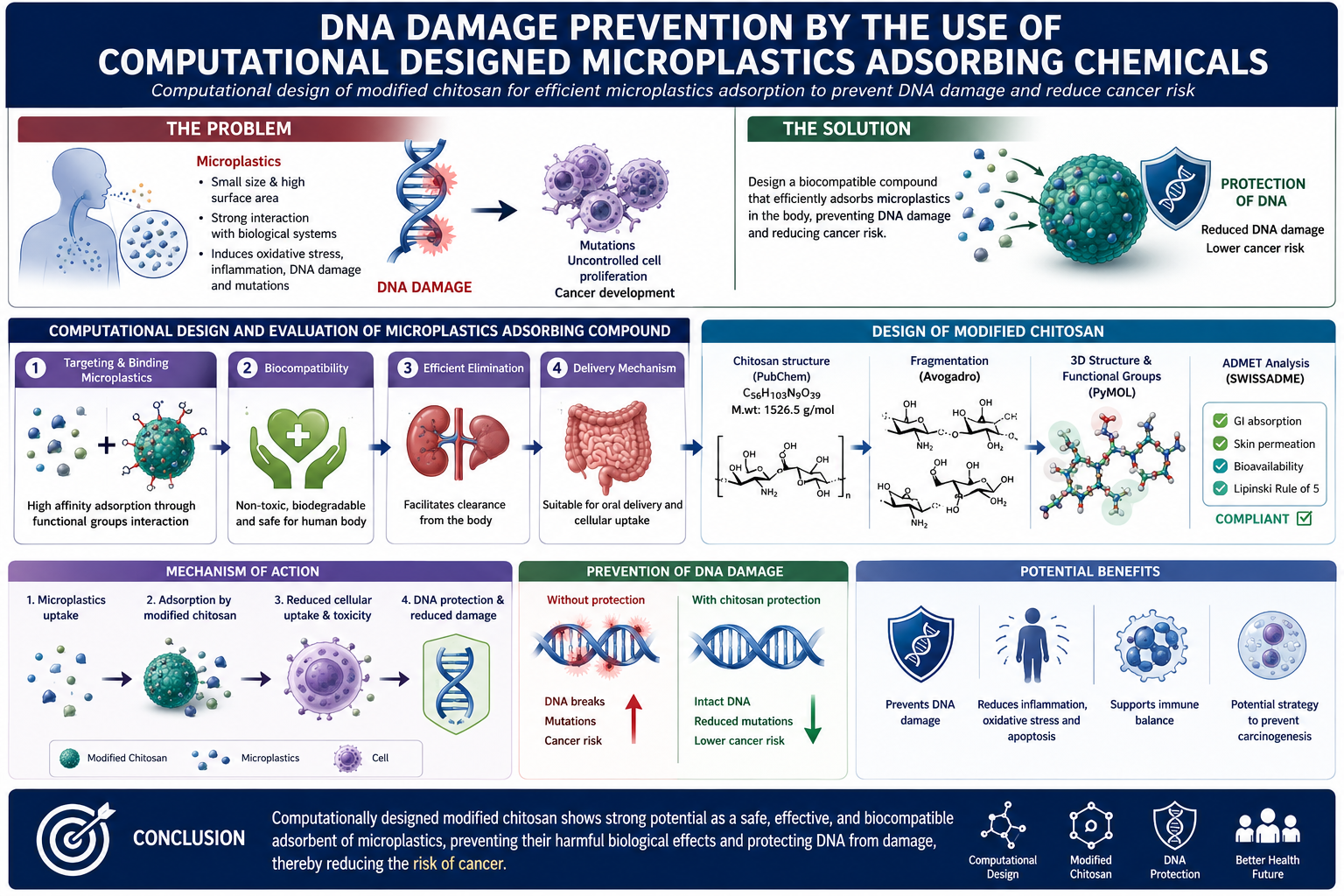
Objective: Design a compound for the efficient absorption of microplastics by the use
of PubChem, Avogadro, PyMOL, and SWISSADME.
Methods: A general approach to designing such a compound include: 1. Targeting
and Binding Microplastics. 2. Biocompatibility. 3. Efficient Elimination. 4. Delivery
Mechanism.
Results: We found that modified chitosan could be the best compounds for
microplastics adsorption from human body. PubChem was used to obtain the
Chitosan chemical structure (C56H103N9O39) M.wt: 1526.5 g/mol. Avogadro was used
for Chitosan fragmentation in to smaller pieces to increase solubility, permeability
through cellular membrane and enhance activity. PyMOL was used to check out the
3D structure and its functional groups. SWISSADME was applied to analyze GI
absorption, skin permeation, bioavailability, and the level of compliance with
Lipinski rules of 5.
Conclusion: This research highlights the potential of chitosan-based compounds as a
prevention strategy for mitigating microplastic-induced carcinogenesis.
Downloads
References
Haripriya S, Vijayalakshmi M, Ala C, Murugesan S, Pavadai P, Kunjiappan S, Pandian SR. Pharmacoinformatics-based prediction of Checkpoint kinase-1 inhibitors from Momordica charantia Linn. for cancer. Computational Biology and Chemistry. 2025 Apr 1;115:108286https://doi.org/10.1016/j.compbiolchem.2025.108286. DOI: https://doi.org/10.1016/j.compbiolchem.2024.108286
Karami-Gadallo L, Ataie-Fashtami L, Ghoranneviss M, Pouladian M, Sardari D. Cell damaging by irradiating non-thermal plasma to the water: Mathematical modeling of chemical processes. Molecular Biology Research Communications. 2018 Sep;7(3):133https://doi.org/10.22099/mbrc.2018.28869.1233. DOI: https://doi.org/10.1016/j.cpme.2017.08.002
Wei C, Zhang H, Niu L, Zhong Q, Yan H, Wang J. 4D-QSAR, ADMET properties, and molecular dynamics simulations for designing N-substituted urea/thioureas as human glutaminyl cyclase inhibitors. Computational Biology and Chemistry. 2024 Oct 1;112:108131https://doi.org/10.1016/j.compbiolchem.2024.108131. DOI: https://doi.org/10.1016/j.compbiolchem.2024.108131
Blackford AN, Jackson SP. ATM, ATR, and DNA-PK: the trinity at the heart of the DNA damage response. Molecular cell. 2017 Jun 15;66(6):801-17https://doi.org/10.1016/j.molcel.2017.05.015. DOI: https://doi.org/10.1016/j.molcel.2017.05.015
Reisländer T, Groelly FJ, Tarsounas M. DNA damage and cancer immunotherapy: a STING in the tale. Molecular cell. 2020 Oct 1;80(1):21-8https://doi.org/10.1016/j.molcel.2020.08.020. DOI: https://doi.org/10.1016/j.molcel.2020.07.026
Galluzzi L, Yamazaki T, Kroemer G. Linking cellular stress responses to systemic homeostasis. Nature Reviews Molecular Cell Biology. 2018 Nov;19(11):731-45https://doi.org/10.1038/s41580-018-0058-6. DOI: https://doi.org/10.1038/s41580-018-0068-0
Klapp V, Álvarez-Abril B, Leuzzi G, Kroemer G, Ciccia A, Galluzzi L. The DNA damage response and inflammation in cancer. Cancer discovery. 2023 Jul 7;13(7):1521-45https://doi.org/10.1158/2159-8290.CD-23-0213. DOI: https://doi.org/10.1158/2159-8290.CD-22-1220
Boekelheide K, Blumberg B, Chapin RE, Cote I, Graziano JH, Janesick A, Lane R, Lillycrop K, Myatt L, States JC, Thayer KA. Predicting later-life outcomes of early-life exposures. Environmental health perspectives. 2012 Oct;120(10):1353-61https://doi.org/10.1289/ehp.1104621. DOI: https://doi.org/10.1289/ehp.1204934
Kundakovic M, Jaric I. The epigenetic link between prenatal adverse environments and neurodevelopmental disorders. Genes. 2017 Mar 18;8(3):104https://doi.org/10.3390/genes8030104. DOI: https://doi.org/10.3390/genes8030104
Kheirabadi M, Maleki J, Soufian S, Hosseini S. Design of new potent HTLV-1 protease inhibitors: in silico study. Molecular Biology Research Communications. 2016 Mar;5(1):19https://doi.org/10.22099/mbrc.2016.2929.
Javanmard A, Azimzadeh-Irani M, Tafazzoli G, Esmaeilzadeh A, Shirinpoor-Kharf M, Haghayeghi SM. In-silico structural analysis of Heterocephalus glaber amyloid beta: an anti-Alzheimer's peptide. Molecular Biology Research Communications. 2024;13(1):29https://doi.org/10.22099/mbrc.2024.4550.
Yang Y, Jalalah M, Alsareii SA, Harraz FA, Thakur N, Zheng Y, Koutb M, Yoon Y, Salama ES. Plastic waste and microplastics (MPs) formation: Management, migration, and environmental impact. Journal of Environmental Chemical Engineering. 2024 May 4:112926 DOI: https://doi.org/10.1016/j.jece.2024.112926
DOI: 10.1016/j.jece.2024.112926. DOI: https://doi.org/10.1016/j.jece.2024.112926
Hartmann NB, Huffer T, Thompson RC, Hassellov M, Verschoor A, Daugaard AE, Rist S, Karlsson T, Brennholt N, Cole M, Herrling MP. Are we speaking the same language? Recommendations for a definition and categorization framework for plastic debris. 2019; 53(3), 1039–1047 DOI: https://doi.org/10.1021/acs.est.8b05297
https://doi.org/10.1016/j.envpol.2019.03.013. DOI: https://doi.org/10.1016/j.envpol.2019.03.013
Yee MS, Hii LW, Looi CK, Lim WM, Wong SF, Kok YY, Tan BK, Wong CY, Leong CO. Impact of microplastics and nanoplastics on human health. Nanomaterials. 2021 Feb 16;11(2):496 DOI: https://doi.org/10.3390/nano11020496
https://doi.org/10.3390/nano11020496. DOI: https://doi.org/10.3390/nano11020496
Li D, Shi Y, Yang L, Xiao L, Kehoe DK, Gun’ko YK, Boland JJ, Wang JJ. Microplastic release from the degradation of polypropylene feeding bottles during infant formula preparation. Nature Food. 2020 Nov;1(11):746-54 DOI: https://doi.org/10.1038/s43016-020-00171-y
https://doi.org/10.1038/s41574-020-00326-2.
Li S, Keenan JI, Shaw IC, Frizelle FA. Could microplastics be a driver for early onset colorectal cancer?. Cancers. 2023 Jun 24;15(13):3323 DOI: https://doi.org/10.3390/cancers15133323
https://doi.org/10.3390/cancers15133323. DOI: https://doi.org/10.3390/cancers15133323
Qiao R, Sheng C, Lu Y, Zhang Y, Ren H, Lemos B. Microplastics induce intestinal inflammation, oxidative stress, and disorders of metabolome and microbiome in zebrafish. Science of the Total Environment. 2019 Apr 20;662:246-53 DOI: https://doi.org/10.1016/j.scitotenv.2019.01.245
DOI: 10.1016/j.scitotenv.2019.01.245. DOI: https://doi.org/10.1016/j.scitotenv.2019.01.245
Roshid A, Abbas K, Aziz IH. Polymorphism Of Angiotensin Converting Enzymegene In A Sample of Iraqi Hypertensive Patient and Its Association with Body Mass Index. Biochemical & Cellular Archives. 2019 Apr 1;19(1)
https://doi.org/10.35080/bca.v19i1.1206.
Im J, Eom HJ, Choi J. Effect of early-life exposure of polystyrene microplastics on behavior and DNA methylation in later life stage of zebrafish. Archives of Environmental Contamination and Toxicology. 2022 May;82(4):558-68 DOI: https://doi.org/10.1007/s00244-022-00924-9
DOI: 10.1007/s00244-022-00924-9. DOI: https://doi.org/10.1007/s00244-022-00924-9
Fadare OO, Wan B, Guo LH, Zhao L. Microplastics from consumer plastic food containers: are we consuming it?. Chemosphere. 2020 Aug 1;253:126787 10.1016/j.chemosphere.2020.126787. DOI: https://doi.org/10.1016/j.chemosphere.2020.126787
Ahmed MB, Rahman MS, Alom J, Hasan MS, Johir MA, Mondal MI, Lee DY, Park J, Zhou JL, Yoon MH. Microplastic particles in the aquatic environment: A systematic review. Science of the Total Environment. 2021 Jun 25;775:145793 https://doi.org/10.1016/j.scitotenv.2021.145793. DOI: https://doi.org/10.1016/j.scitotenv.2021.145793
Mohamed Nor NH, Koelmans AA. Transfer of PCBs from microplastics under simulated gut fluid conditions is biphasic and reversible. Environmental science & technology. 2019 Jan 14;53(4):1874-83 DOI: https://doi.org/10.1021/acs.est.8b05143
https://doi.org/10.1021/acs.est.8b06288.
Segovia-Mendoza M, de León CT, García-Becerra R, Ambrosio J, Nava-Castro KE, Morales-Montor J. The chemical environmental pollutants BPA and BPS induce alterations of the proteomic profile of different phenotypes of human breast cancer cells: A proposed interactome. Environmental Research. 2020 Dec 1;191:109960 DOI: https://doi.org/10.1016/j.envres.2020.109960
https://doi.org/10.1016/j.envres.2020.109960. DOI: https://doi.org/10.1016/j.envres.2020.109960
Yin K, Wang Y, Zhao H, Wang D, Guo M, Mu M, Liu Y, Nie X, Li B, Li J, Xing M. A comparative review of microplastics and nanoplastics: Toxicity hazards on digestive, reproductive and nervous system. Science of the total environment. 2021 Jun 20;774:145758 DOI: https://doi.org/10.1016/j.scitotenv.2021.145758
https://doi.org/10.1016/j.scitotenv.2021.145758. DOI: https://doi.org/10.1016/j.scitotenv.2021.145758
Campanale C, Massarelli C, Savino I, Locaputo V, Uricchio VF. A detailed review study on potential effects of microplastics and additives of concern on human health. International journal of environmental research and public health. 2020 Feb;17(4):1212 DOI: https://doi.org/10.3390/ijerph17041212
https://doi.org/10.3390/ijerph17041212. DOI: https://doi.org/10.3390/ijerph17041212
Zhao K, Wei Y, Dong J, Zhao P, Wang Y, Pan X, Wang J. Separation and characterization of microplastic and nanoplastic particles in marine environment. Environmental Pollution. 2022 Mar 15;297:118773 DOI: https://doi.org/10.1016/j.envpol.2021.118773
https://doi.org/10.1016/j.envpol.2021.118773. DOI: https://doi.org/10.1016/j.envpol.2021.118773
Smith M, Love DC, Rochman CM, Neff RA. Microplastics in seafood and the implications for human health. Current environmental health reports. 2018 Sep;5:375-86 DOI: https://doi.org/10.1007/s40572-018-0206-z
https://doi.org/10.1007/s40572-018-0206-1.
Sharma S, Sharma B, Sadhu SD. Microplastic profusion in food and drinking water: are microplastics becoming a macroproblem?. Environmental Science: Processes & Impacts. 2022;24(7):992-1009 DOI: https://doi.org/10.1039/D1EM00553G
https://doi.org/10.1039/d2em00072a.
Sahan KA, Aziz IH, Dawood SN, Al Qazzaz H. The role of resistin gene polymorphism in Iraqi breast cancer patients. Biomedicine. 2022 Dec 31;42(6):1296-300https://doi.org/10.38013/biomedicine.42.6.1296-1300. DOI: https://doi.org/10.51248/.v42i6.2393
Potischman N, Troisi R. In-utero and early life exposures in relation to risk of breast cancer. Cancer Causes & Control. 1999 Dec;10:561-73 DOI: https://doi.org/10.1023/A:1008955110868
https://doi.org/10.1023/A:1008891105171.
Ma L, Yu H, Wang X, Li D, Zhang Y, Pei X, Duan Z, Ma M. The effects of maternal exposure to BPA during pregnancy on the male reproductive system and the testicular microRNA expression profile. Environmental Science and Pollution Research. 2020 May;27:17290-302. DOI: https://doi.org/10.1007/s11356-020-08156-x
Rai N, Kailashiya V, Gautam V. Exploring the protective effect against 7, 12-dimethylbenz [a] anthracene-induced breast tumors of palmitoylethanolamide. ACS Pharmacology & Translational Science. 2023 Dec 1;7(1):97-109. DOI: https://doi.org/10.1021/acsptsci.3c00188
Sahan, K. A., Aziz, I. H., Dawood, S. N., & Abdul Razzaq, S. S. (2023). The effect of genetic polymorphism of resistin gene among iraqi breast cancer women. Iraqi journal of biotechnology, 22(1), 1-7.
Segovia‐Mendoza M, Nava‐Castro KE, Palacios‐Arreola MI, Garay‐Canales C, Morales‐Montor J. How microplastic components influence the immune system and impact on children health: Focus on cancer. Birth defects research. 2020 Oct;112(17):1341-61. DOI: https://doi.org/10.1002/bdr2.1779
Xia L, Gu W, Zhang M, Chang YN, Chen K, Bai X, Yu L, Li J, Li S, Xing G. Endocytosed nanoparticles hold endosomes and stimulate binucleated cells formation. Particle and fibre toxicology. 2016 Dec;13:1-2. DOI: https://doi.org/10.1186/s12989-016-0173-1
Prata JC, Da Costa JP, Lopes I, Duarte AC, Rocha-Santos T. Environmental exposure to microplastics: An overview on possible human health effects. Science of the total environment. 2020 Feb 1;702:134455. DOI: https://doi.org/10.1016/j.scitotenv.2019.134455
Chatterjee S, Sharma S. Microplastics in our oceans and marine health. Field Actions Science Reports. The Journal of Field Actions. 2019 Mar 1(Special Issue 19):54-61.
Kim H, Zaheer J, Choi EJ, Kim JS. Enhanced ASGR2 by microplastic exposure leads to resistance to therapy in gastric cancer. Theranostics. 2022 Apr 4;12(7):3217. DOI: https://doi.org/10.7150/thno.73226
Wang Y, Xu X, Jiang G. Microplastics exposure promotes the proliferation of skin cancer cells but inhibits the growth of normal skin cells by regulating the inflammatory process. Ecotoxicology and Environmental Safety. 2023 Nov 15;267:115636. DOI: https://doi.org/10.1016/j.ecoenv.2023.115636
Abdulhameed AS, Al Omari RH, Althahban S, Jazaa Y, Abualhaija M, Algburi S. Green vegetable waste composited with chitosan as a bioadsorbent for effective removal of methylene blue dye from water: Insight into physicochemical and adsorption characteristics. Biomass and Bioenergy. 2025 Feb 1; 193:10752810.20517/wecn.2024.09 . DOI: https://doi.org/10.1016/j.biombioe.2024.107528
Biswas UK, Bose A, Ghosh B, Sharma S. An insight into chemically modified chitosan and their biological, pharmaceutical, and medical applications: A review. International Journal of Biological Macromolecules. 2025 Feb 3:140612. DOI: https://doi.org/10.1016/j.ijbiomac.2025.140612
Singh R, Singh K. Lipinski s Rule of Five. In2-Deoxy-D-Glucose: Chemistry and Biology 2024 Nov 15 (pp. 242-246). Bentham Science Publishers. DOI: https://doi.org/10.2174/9789815305159124010015
Mostafa MA, Ibrahim MA, Badran AS. Spectroscopic elucidation, quantum chemical computations (FMO, HOMO–LUMO, MEP, NLO), and biological activity on some novel heterocyclic compounds using 3-substituted-6, 8-dimethylchromones. Synthetic Communications. 2024 Sep 16;54(18):1523-50. DOI: https://doi.org/10.1080/00397911.2024.2394833
Gupta S, Vasanth D, Kumar A. Physicochemical analysis of chitosan oligosaccharide revealed its usefulness in effective delivery of drugs. Journal of Biomaterials Science, Polymer Edition. 2025 Jan 2;36(1):45-63. DOI: https://doi.org/10.1080/09205063.2024.2392365
Marianti A, Amalina ND, Mursiti S, Sitompul FN, Futri SS, Negara LG, Sholehah IK, Asmorowati DS, Astari PD. Pharmacokinetics Profile of Chitosan Nanoparticles in Chronic Lead-induced Toxicity Rats Model. Biosaintifika: Journal of Biology & Biology Education. 2024 Apr 20;15(1). DOI: https://doi.org/10.15294/biosaintifika.v15i1.1857
Nicolaescu OE, Belu I, Mocanu AG, Manda VC, Rău G, Pîrvu AS, Ionescu C, Ciulu-Costinescu F, Popescu M, Ciocîlteu MV. Cyclodextrins: Enhancing Drug Delivery, Solubility and Bioavailability for Modern Therapeutics. Pharmaceutics. 2025 Feb 22;17(3):288. DOI: https://doi.org/10.3390/pharmaceutics17030288
Kong C, Wang K, Sun L, Zhao H, Wang T, Zhou W, Wu D, Xu F. Novel carbon dots derived from moutan cortex significantly improve the solubility and bioavailability of mangiferin. International Journal of Nanomedicine. 2024 Dec 31:3611-22. DOI: https://doi.org/10.2147/IJN.S456053
Additional Files
Published
Issue
Section
Categories
License
Copyright (c) 2025 Khadija Abbas Sahan, Zahraa Abbas Sahan

This work is licensed under a Creative Commons Attribution 4.0 International License.
The authors retain all proprietary rights, including copyright, such as patent and trademark rights and rights to any process or procedure described in the article.