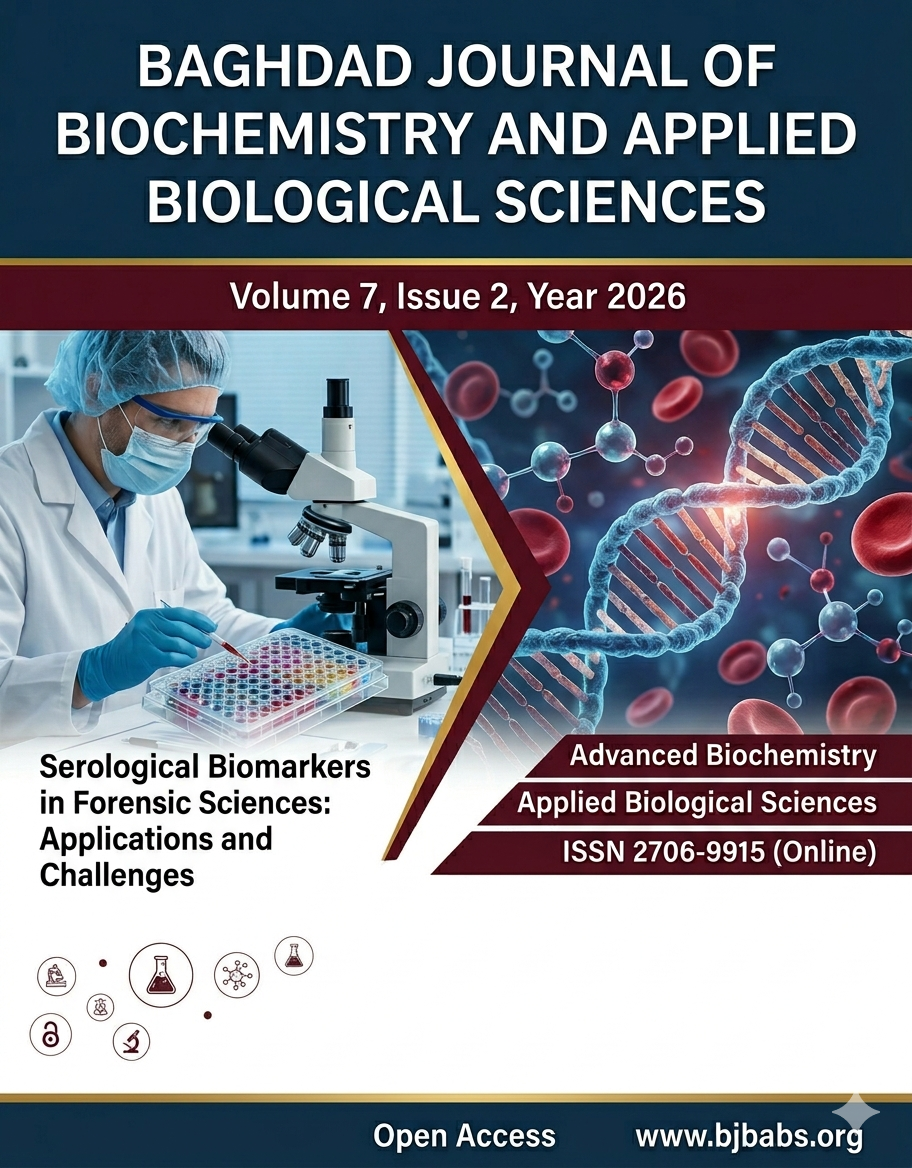
Serological Biomarkers in Forensic Science
A Review
DOI:
https://doi.org/10.47419/bjbabs.v7i2.449Keywords:
Forensic science, Serological Biomarkers, Biological Evidence, Body FluidAbstract
Background: Biological evidences, e.g. blood, semen, vaginal secretion, saliva, urine, and sweat encountered at the crime scene, are the most pervasive in surroundings. Their existence helps in associating the assassin with the victim as well as with the crime scene. Our motivation for writing this review was the lack of a recent, thorough review on the subject appropriate for the use of all scientists involved with serological research in forensic science.
Objective: This comprehensive review aims to discuss the value of serological biomarkers for a wide variety of forensic applications.
Methods: This review summarizes a comprehensive body of work on serological biomarkers, with the inclusion of all types of markers and advanced methodologies available. It discusses a plethora of methodologies used to differentiate between body fluids, with a deeper look at emerging, high-throughput techniques.
Results: The review provides a detailed discussion on both established body fluids and novel serological markers. It acknowledges the difficulties involved in selecting a body fluid differentiation methodology for forensic contexts. A key trend noted is the use of an interdisciplinary approach in the most recent publications.
Conclusion: The interdisciplinary approach is essential for the future of forensic work and is necessary for success in protein and body fluid research. This review serves as a thorough summary of serological biomarkers and their applications, capturing the overall trends in the field.
Downloads
References
Alavani MVS. AN EXPERIMENTAL ANALYSIS OF BLOOD IN FORENSIC SCIENCE: BLOOD STAIN PATTERN. researchgate.net. . researchgate.net
Yadav PK, Sharma S. Application of Forensic Techniques to Blood Analysis. InAdvancements in Body Fluid Analysis in Forensics: Current and Emerging Methods 2024 Sep 1 (pp. 17-90). Cham: Springer Nature Switzerland. [HTML]
Zhou J, Chen J, Peng Y, Xie Y et al. A promising tool in serological diagnosis: current research Progress of antigenic epitopes in infectious diseases. Pathogens. 2022. mdpi.com
Chavez‐Pineda OG, Rodriguez‐Moncayo R, Cedillo‐Alcantar DF, Guevara‐Pantoja PE, Amador‐Hernandez JU, Garcia‐Cordero JL. Microfluidic systems for the analysis of blood‐derived molecular biomarkers. Electrophoresis. 2022 Sep;43(16-17):1667-700. [HTML]
Wohlfahrt D, Tan-Torres AL, Green R, Brim K, Bradley N, Brand A, Abshier E, Nogales F, Babcock K, Brooks JP, Seashols-Williams S. A bacterial signature-based method for the identification of seven forensically relevant human body fluids. Forensic Science International: Genetics. 2023 Jul 1;65:102865. [HTML]
Malhotra S, Jamir L. Application of Forensic Biology in Criminal Justice System. Forensic Justice. 2024. [HTML]
Kaleem M, Munawar A, Maqbool A. Revealing the role of proteins in the field of forensic investigations. Forensic Insights and Health Sciences Bulletin. 2024 Apr 30;2(1):29-39. ammanif.com
Ahmad A, Imran M, Ahsan H. Biomarkers as biomedical bioindicators: approaches and techniques for the detection, analysis, and validation of novel Biomarkers of diseases. Pharmaceutics. 2023. mdpi.com
Kramvis A, Chang KM, Dandri M, Farci P, Glebe D, Hu J, Janssen HL, Lau DT, Penicaud C, Pollicino T, Testoni B. A roadmap for serum biomarkers for hepatitis B virus: current status and future outlook. Nature Reviews Gastroenterology & Hepatology. 2022 Nov;19(11):727-45. nature.com
Pekarek L, Garrido-Gil MJ, Sánchez-Cendra A, Cassinello J, Pekarek T, Fraile-Martinez O, García-Montero C, Lopez-Gonzalez L, Rios-Parra A, Álvarez-Mon M, Acero J. Emerging histological and serological biomarkers in oral squamous cell carcinoma: Applications in diagnosis, prognosis evaluation and personalized therapeutics. Oncology Reports. 2023 Oct 20;50(6):213. spandidos-publications.com
Additional Files
Published
License
Copyright (c) 2026 Dunya Abdullah Mohammed, Omar A. Mahmoud, Sahar M. Ibrahim, Farah Badri Abed, Muhammed A. Hameed, Shahrazad H. Muhi

This work is licensed under a Creative Commons Attribution 4.0 International License.
The authors retain all proprietary rights, including copyright, such as patent and trademark rights and rights to any process or procedure described in the article.
How to Cite